
100% Free Love Test
A quick score is fun solo. Shared on purpose, it turns into something worth remembering — zero cost, zero overthinking.
Most people who search for a 100% free love test — or a love compatibility test, a love meter, whatever the search bar suggested — want one of two things: a quick, private number out of pure curiosity, or a fun way to pull someone else into the moment with them. The first one takes ten seconds. The second one is where a name-based love test actually earns its place as more than a novelty — and there’s real psychology behind why that’s true, not just marketing copy.
Why doing it together beats doing it alone
This isn’t just a nicer way to spend a Friday night. Relationship researcher Arthur Aron’s self-expansion model, built on decades of studies with couples, found that partners who regularly do something novel and a little exciting together report meaningfully higher relationship satisfaction than couples who mostly stick to familiar routines. A love test alone is information. A love test run together, with reactions and a bit of teasing attached, is a small novel experience — exactly the kind of low-effort, shared moment the research points to as good for a relationship, even though the test itself is just for fun.
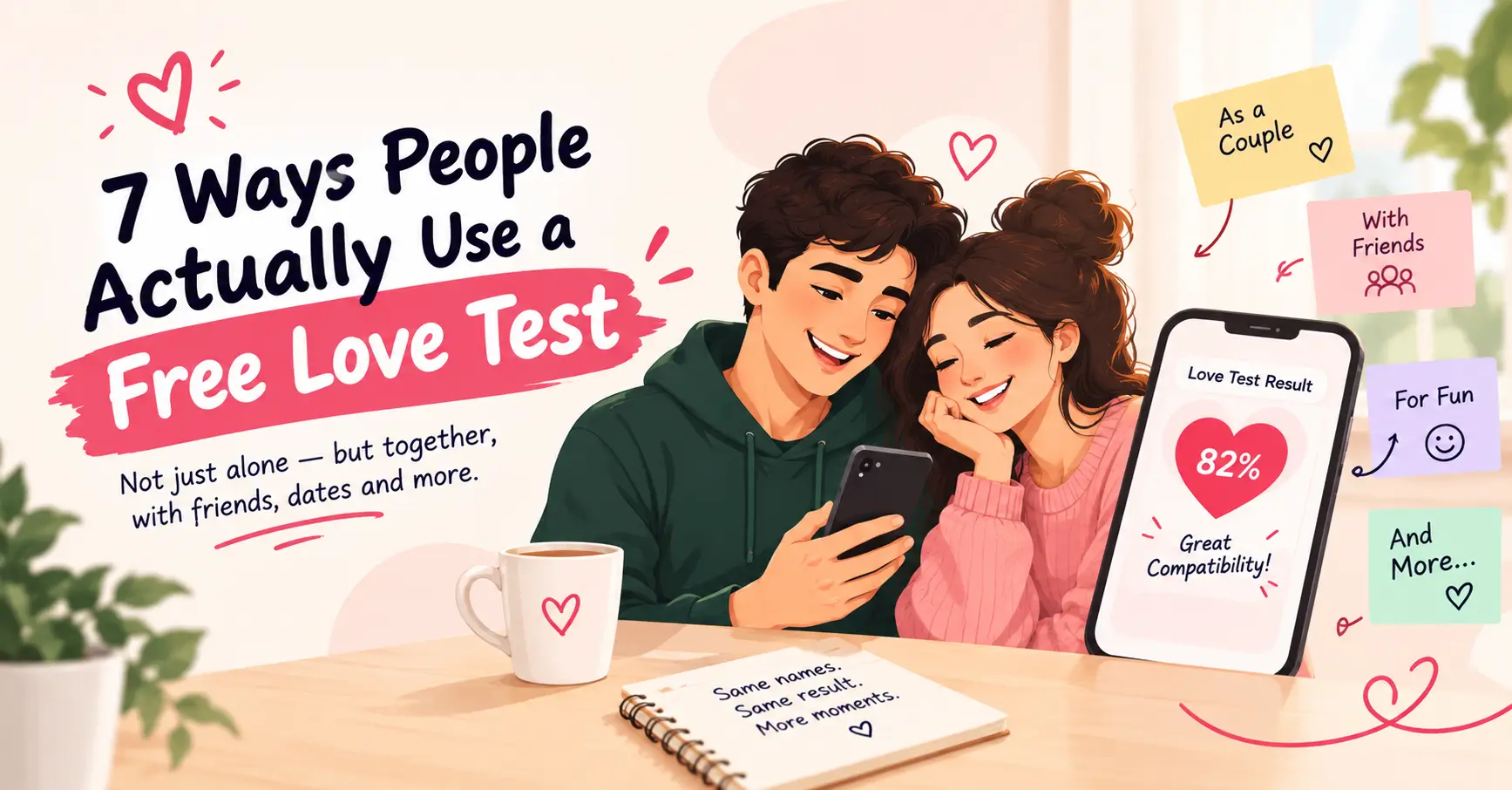
7 ways people actually use a free love test
1. Guess the score before you run it
Each person privately writes down or whispers a guess before hitting calculate. The two-second compatibility test suddenly becomes a five-minute conversation, because guessing forces both people to say out loud how compatible they actually feel — which was the real point all along, regardless of what number shows up.
2. Run it on your past matches for comedy, then run it on each other
Testing an ex, a celebrity crush, or a random name for the joke of it is genuinely one of the most common ways this gets used. It’s low stakes, usually funny, and it almost always ends the same way: someone reaches for the “real” love test calculator next to check what they and their actual crush get — which tends to be the reason someone opened the page in the first place.
3. Use it as a low-pressure first or second date icebreaker
It sounds cheesy written down, but in practice it works better than most planned icebreakers, because both people know it’s not a serious verdict. That shared awareness of “we both know this is silly” is exactly what makes it safe to laugh about and easy to segue from into a real conversation about what each of you is actually looking for.
4. Turn it into a recurring check-in, not a one-time thing
Some couples run a love or compatibility test monthly, or on an anniversary, not because the number means anything different each time, but because it becomes a small excuse to sit down together. Screenshotting results side by side over months or years turns into its own kind of memory-keeping — the score is incidental; the recurring habit of checking in isn’t.
5. Make it a group activity, not just a couple’s thing
Friend groups, siblings, and even families run these at gatherings — matching up friends, crushes, or pets’ names for laughs. It’s a zero-prep group activity that reliably gets a room talking, which is why it shows up so often at sleepovers, game nights, and long car rides.
6. Compare notes with a friend, not just a partner
You don’t need to be dating someone for this to be worth running. A lot of people test their compatibility with a close friend or sibling purely out of curiosity about the tool itself, then end up comparing results with a partner afterward. Since the same names always return the same score on a properly built calculator, it also works as a stable reference point you can bring up again later, almost like an inside joke.
7. Use a low score on purpose, as a conversation starter
A low number is usually treated as a disappointment, but some couples flip it: a surprisingly low score becomes the opening line for “okay, so what do you think we’re actually good at, then?” Since the score is about letters, not the relationship itself, treating a low result as a prompt rather than a verdict tends to lead to a more interesting conversation than a high score would have.
When a free love test is the wrong fit
| Situation | Better fit |
|---|---|
| Quick fun with a crush or friend group | A free love test by name — this is exactly what it’s built for |
| Weighing an actual marriage decision | A proper marriage compatibility reading, not a name-based score |
| Wanting daily astrological context, not a one-off score | A daily love horoscope |
| Tracking how a relationship has actually progressed over time | A relationship timeline calculator |
Common mistakes people make with this
- Treating a low score as a real verdict. It measures letters, not communication, trust, or history together.
- Running it alone every time. The number is the same whether you’re alone or not — the shared reaction is what actually makes it worth doing.
- Mixing nicknames and full names between runs. “Ana” and “Ananya” will not score the same, so pick one version if you want to compare results later.
- Expecting a different score on repeat. On a properly built, deterministic calculator, the same two names always return the same result. If a site gives you a new number every time, that’s randomness, not a changing compatibility.
- Using it to settle an actual argument. It’s built for fun, not for evidence in a real disagreement.
Frequently asked questions
Is a love compatibility test the same as a love meter or a true love test?
Yes — love test, love meter, compatibility test, and true love test are all different names for the same basic idea: two names in, one percentage out. The wording changes depending on what someone types into the search bar, not what the tool actually does.
Is a free love test actually free, no hidden signup?
Yes, ours has no signup, no payment, and no limit on how many times you run it.
Is it better to do a love test with someone else instead of alone?
Both are fine, but research on shared novel activities suggests doing it together adds a small, genuine relationship benefit that doing it solo doesn’t — the activity itself matters less than doing something a little different together.
Does the score change if we run it again later?
Not on a properly built, deterministic tool. The same two names will return the same score every time, whether you run it today or in a year.
Can we use this for friends, not just couples?
Yes. Plenty of people run it on friends, siblings, or even pets, purely for the fun of it.
What if the score is low — does that mean anything real?
No. It reflects a letter-based pattern, not the actual relationship. Some of the strongest real relationships would score unremarkably on a tool like this.
Try our other calculators
This article and the linked love test are for entertainment purposes only. Results are generated by a name-based formula and are not a scientific or psychological assessment of any relationship.