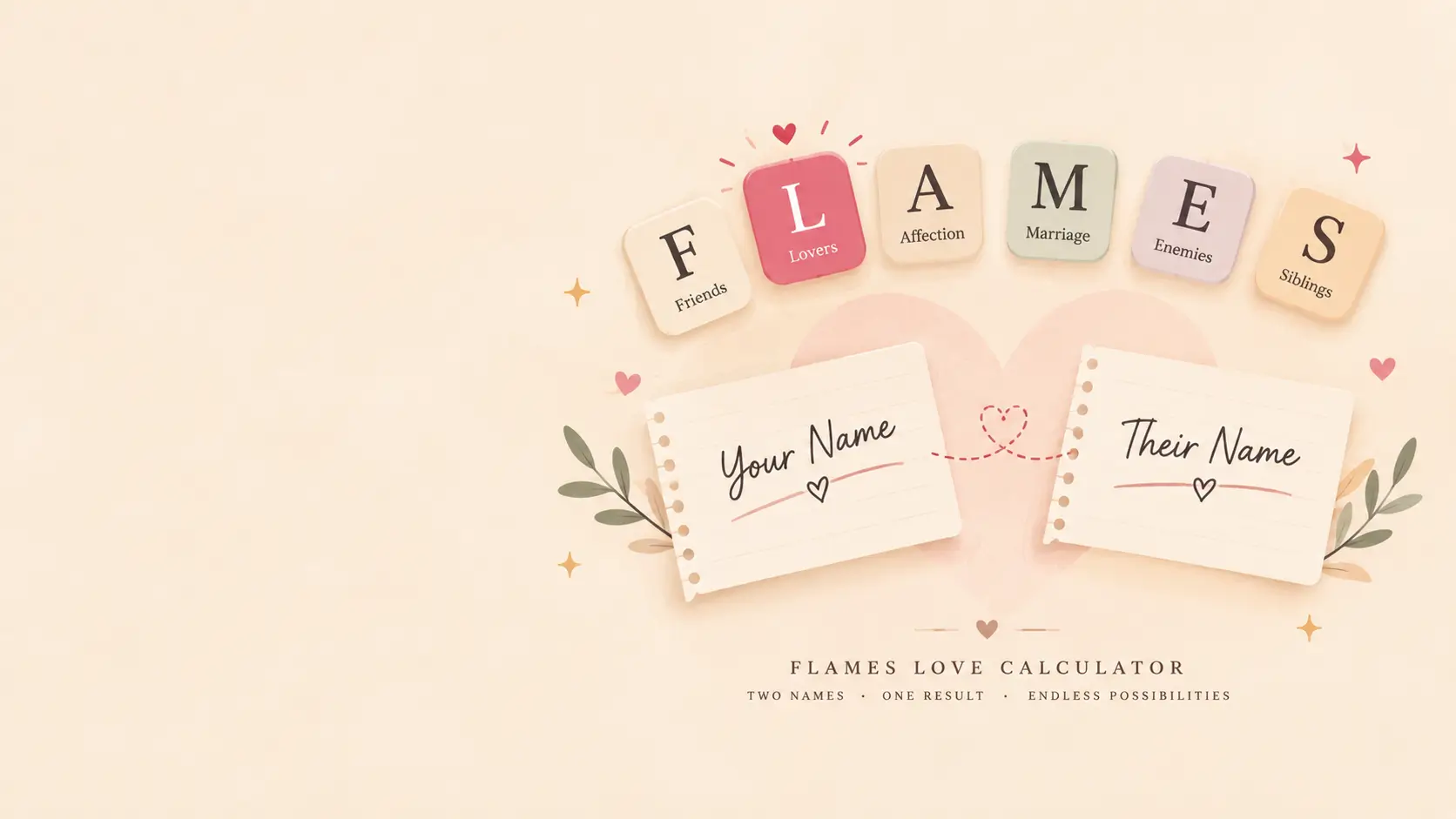
FLAMES Calculator by Name
Friends, Lovers, Affection, Marriage, Enemies, or Siblings — the classic notebook game, run instantly.
Enter two names.
Let FLAMES decide.
The classic school-time name game, rebuilt for the web. Match common letters, count what remains, and cycle through F-L-A-M-E-S until one relationship type is left.
Lovers
How this FLAMES calculator works
- Spaces, punctuation and letter case are ignored.
- Each matching letter is removed once from each name.
- The remaining letters from both names are added together to make one count.
- That count is used to eliminate letters around F-L-A-M-E-S.
- Counting continues from the next position after every elimination.
- The final surviving letter is your FLAMES result.
Remember the FLAMES game? Two names, a pencil, and the back of a notebook page during a boring class period. You’d cross out matching letters, count what was left, and hope the final letter wasn’t “E.” That childhood game is still one of the most searched name games in India, and now you can play it without wasting paper.
Just enter your name and the other person’s name in the calculator above, hit the button, and your FLAMES result appears in a couple of seconds, no formulas to remember, no letters to cross out by hand.
What Does FLAMES Stand For?
FLAMES is short for six possible outcomes between two people:
| Letter | Stands For | What It Represents |
|---|---|---|
| F | Friends | A close, trust-based bond |
| L | Lovers | Romantic pull and attraction |
| A | Affection | Warmth and fondness, not quite romance |
| M | Marriage | Long-term, deep compatibility |
| E | Enemies | Tension or friction between two people |
| S | Siblings | A protective, family-like closeness |
Every time you run two names through the calculator, the algorithm eliminates letters one by one until only one of these six remains, and that letter becomes your result.
Where Did the FLAMES Game Come From?
Nobody really knows who invented FLAMES, and that’s part of its charm. It wasn’t built by a company or published in a book, it spread the old-fashioned way, passed from one student to another in school corridors across India and neighbouring countries somewhere in the early 1990s.
Before smartphones existed, this was the original “compatibility test.” A classmate would grab your notebook, scribble two names on the corner of a page, cancel out the common letters, and count what remained. The whole class would lean in for the reveal. Decades later, the paper version has simply moved to a screen, same logic, same six outcomes, minus the eraser marks.
How the FLAMES Formula Actually Works
Most sites just show you a letter and move on. Here’s the actual method behind it, step by step, using two sample names so you can double-check the logic yourself.
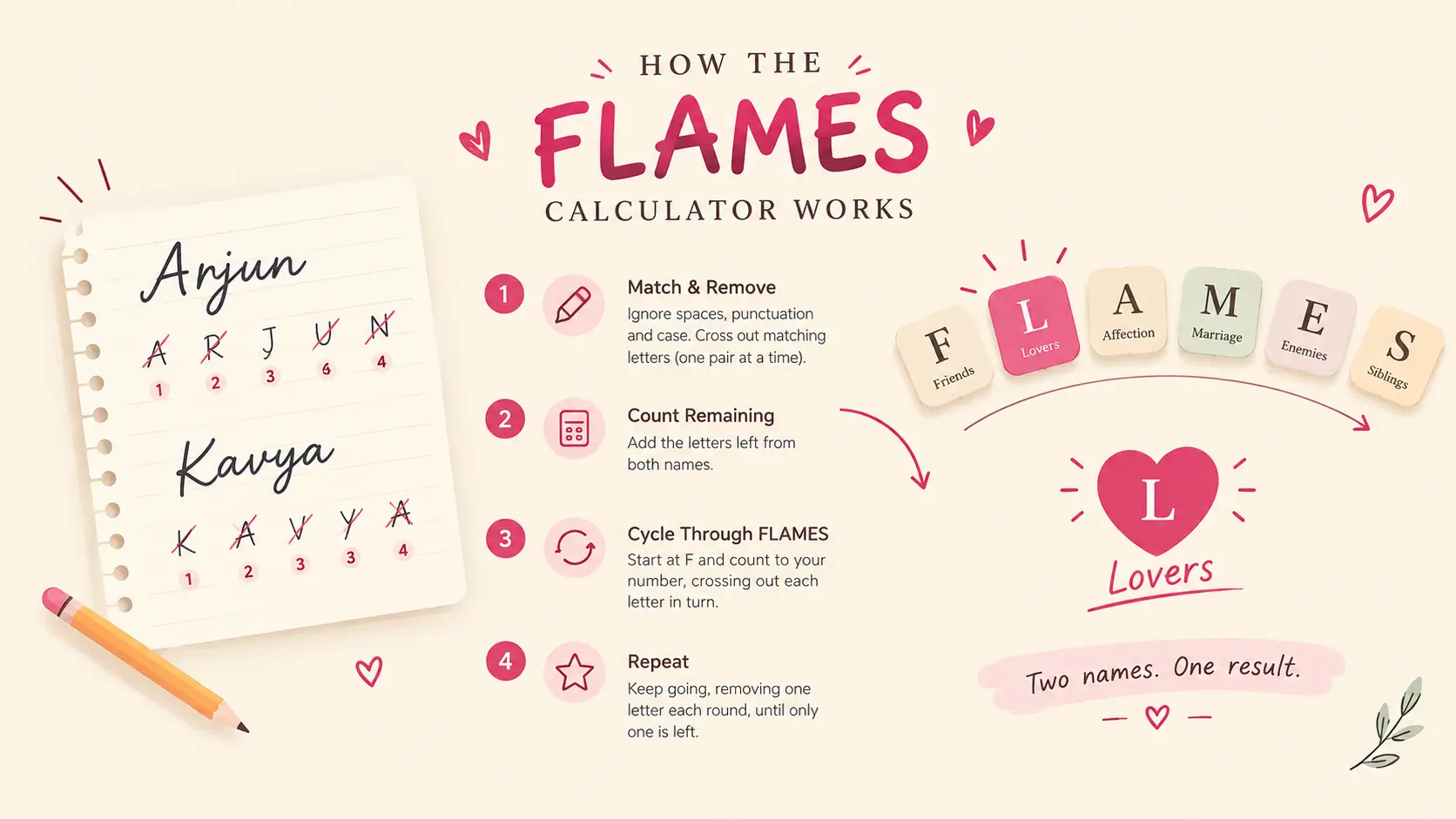
Example: ARJUN and KAVYA
Step 1, write out both names in full. Ignore spaces, capital letters, and punctuation. Only the letters themselves count.
Step 2, cancel matching letters, one pair at a time.
- A appears in both ARJUN and KAVYA, so cancel one A from each
- After cancelling: ARJUN leaves R, J, U, N and KAVYA leaves K, V, Y
Step 3, count what’s left. 4 letters remain from ARJUN plus 4 letters remain from KAVYA, which equals 8.
Step 4, cycle through F-L-A-M-E-S. Starting at F, count to 8: F(1) L(2) A(3) M(4) E(5) S(6) F(7) L(8), so L is crossed out.
Remaining: F, A, M, E, S. Count to 8 again starting after L: F(1) A(2) M(3) E(4) S(5) F(6) A(7) M(8), so M is crossed out.
Remaining: F, A, E, S. Continue counting to 8, cross out the next letter the count lands on, and repeat the process, dropping one letter each round, until a single letter is left standing.
That final surviving letter is the FLAMES result. It’s a small amount of manual counting, which is exactly why the online version exists: the calculator runs this same elimination process instantly instead of you doing it by hand.
About the FLAMES Percentage
Some versions of this tool also show a percentage next to the letter. That number simply reflects how many letters overlapped between the two names compared to the total letters used. A higher overlap gives a higher FLAMES love calculator percentage, it’s not a second scoring system, just a different way of visualising the same letter count.
How to Use This Calculator
- Type your name in the first box, first name, full name, or nickname all work.
- Type the second name, a crush, a friend, a sibling, anyone you’re curious about.
- Press calculate and let the tool run the elimination process for you.
- Check your letter and read what it means below.
- Run it again with a different spelling or your full name instead of a short form, the result can change depending on exactly what you type.
What Your FLAMES Letter Actually Means
F, Friends: The kind of bond built on comfort rather than performance. You don’t need to impress this person, you already get along.
L, Lovers: This is usually the result people are secretly hoping for. It points toward romantic attraction, though whether it’s mutual is something only a real conversation can answer.
A, Affection: The in-between zone. Genuine warmth and care that hasn’t been labelled as friendship or romance yet, plenty of relationships live here comfortably.
M, Marriage: Considered the “big” result. It suggests a deep, long-haul kind of compatibility, at least by the game’s own logic.
E, Enemies: Not as bad as it sounds. Friction usually means two people notice each other more than they’d like to admit, plenty of stories start with an E.
S, Siblings: A loyal, low-drama closeness. The kind of relationship where you can disagree without it changing anything.
FLAMES Calculator vs Love Calculator by Name
Both tools use two names as input, but the output is different. If you want something more detailed than either, our full love compatibility test goes a step further than a single letter or percentage.
| Point | FLAMES Calculator | Love Calculator by Name |
|---|---|---|
| Output | One of six categories | A love percentage (0–100%) |
| Best for | Quick, shareable fun with friends | A more detailed compatibility score |
| Origin | 90s notebook game | Modern numerology-style tools |
| Time needed | A few seconds | A few seconds |
Who Actually Plays FLAMES Today?
- School and college students, this is still where the game lives most. It moved from notebooks to phones, but the audience hasn’t changed much in thirty years.
- Anyone testing a crush, typing a crush’s name into a compatibility test is basically a rite of passage at this point, and FLAMES has always been the low-pressure way to do it.
- People feeling nostalgic, plenty of adults open this up purely to relive a very specific kind of recess-era excitement.
- Friend groups, someone always insists the calculator “got it wrong” for their result, which somehow makes the game more fun, not less.
- Instagram and WhatsApp status culture, FLAMES results get screenshotted and shared constantly, especially with celebrity or fictional name combinations.
A Few Things to Keep in Mind
- Spelling changes the result. “Priya” and “Priyaa” won’t give the same letter count, so don’t be surprised if variations give different answers.
- Full name vs nickname matters. Using a short form for yourself and a full name for the other person will skew the count, pick one style and stay consistent.
- The same input always gives the same output. There’s no randomness built in, so if you test the same spelling twice, expect an identical result both times.
- It’s a name game, not a prediction. Whatever letter shows up, it’s based on letter counting, not on how you two actually get along.
Is FLAMES Actually Accurate?
Not in any scientific sense, and it was never meant to be. The calculator doesn’t know your personalities, your history, or how you communicate. What it does offer is consistency: the same two names, spelled the same way, will always land on the same letter. There’s no hidden randomness in the process.
Think of it the way you’d think of a fortune cookie, genuinely fun to read, occasionally uncannily on point, but not something to base a real decision on. The value isn’t in accuracy, it’s in the few seconds of “wait, really?” before you show your friends the result.
Frequently Asked Questions
What is the full form of FLAMES?
Friends, Lovers, Affection, Marriage, Enemies, Siblings, six possible outcomes based on the letters shared between two names.
How is the FLAMES result calculated?
By cancelling matching letters between two names one pair at a time, counting what’s left, and cycling through F-L-A-M-E-S with that number until a single letter remains.
Can I use just first names?
Yes, first names, full names, and nicknames are all valid. Just stay consistent so your comparisons make sense.
Will I get the same result every time?
With the exact same spelling, yes. The calculation has no random element, so identical input always produces an identical output.
What does the FLAMES percentage mean?
It shows how many letters overlapped between the two names relative to the total count, a supporting number alongside the main letter result, not a separate score.
Is there a FLAMES calculator based on date of birth?
The traditional FLAMES game only uses letters from names. If you’re looking for a date-based compatibility check instead, that’s a separate calculation from the letter-based FLAMES method.
Is the FLAMES game the same as a love percentage calculator?
No. FLAMES sorts two names into one of six categories, while a love percentage calculator gives you a numeric score out of 100. Both are entertainment-based name matching tools, just with different outputs.
Can FLAMES be used for friendship compatibility too?
Yes, the F and S results are both about platonic closeness, just different flavours of it. F leans toward chosen friendship, S leans toward a family-style bond.
Try It Now
Two names, a few seconds, one letter. Enter your name and theirs above and see where the count lands, and if you’re curious about a numeric score instead, our love percentage calculator is right there too.
Explore More Tools
Free tools for the rest of your relationship, compatibility, and daily astrology questions. All calculated instantly, all free.
FLAMES is a classic name game for entertainment purposes only and is not a scientific or psychological assessment of any relationship.