
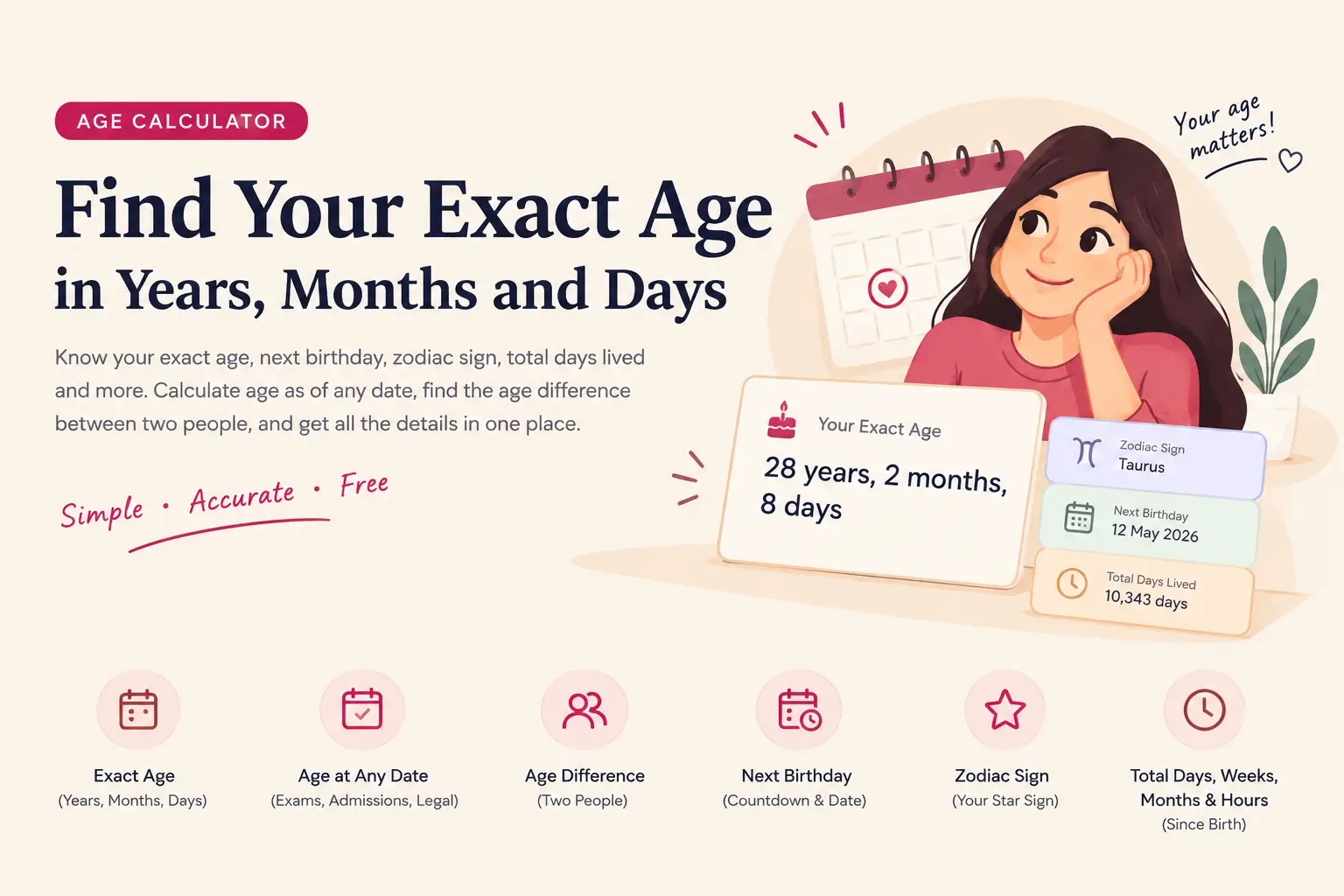
Age Calculator
Most people who search for an age calculator want one of two things: a quick answer to “how old am I today,” or a precise number tied to something official — an exam cut-off date, a school admission form, a passport application. This guide covers both, along with the formulas behind the calculation, how age rules work for Indian exams and legal purposes, and the mistakes people commonly make when they try to work it out by hand.
How to calculate your age
Enter your date of birth, and if you need your age as of a particular date rather than today, set that too — useful for exam eligibility, school admissions, insurance forms, or simple curiosity. The calculator works out your completed years, months, and days, automatically adjusting for month lengths and leap years so you don't have to check whether February has 28 or 29 days.
If you're working it out manually, the logic is:
- Subtract your birth year from the current (or target) year.
- Check whether your birthday has occurred yet in that year. If yes, keep that number. If not, subtract one more year.
- Count the months from your last birthday to the target date.
- Count the remaining days from your last monthly "day" to the target date.
Worked example: Born 15 May 1998, target date 23 July 2026.
- Years: 2026 − 1998 = 28
- Your birthday (15 May) has already passed by 23 July, so no adjustment needed.
- Months: 7 − 5 = 2
- Days: 23 − 15 = 8
- Exact age: 28 years, 2 months, 8 days
That's the same calculation the tool above runs automatically, including the borrowing logic for months and years when the target date falls before the birth day-of-month.
Age from birth year alone
If you only know a birth year — common with older family records or documents that just say "born 1988" — you can only get an approximate age, since without a specific date the calculator can't know whether that year's birthday has passed. For anything official — exam forms, ID applications, passport renewal — always use the full date of birth; a year-only estimate can be off by close to a full year.
Calculating age for Indian competitive exams
This is one of the most common reasons people look up an age calculator in India, and it's also where the most mistakes happen. Government exams almost never calculate your age "as of today" — they calculate it as of a specific cut-off date stated in the official notification, and your age on that date can differ meaningfully from your age right now.
To use an age calculator correctly for this purpose, set the reference date to the cut-off date given in your exam notification rather than today's date.
Typical cut-off patterns for major Indian exams (always confirm against the current year's official notification, since dates can shift):
| Exam | General Age Limit | OBC | SC/ST | Typical Cut-off |
|---|---|---|---|---|
| UPSC Civil Services (IAS/IPS) | 21–32 years | +3 years | +5 years | 1 August |
| SSC CGL | 18–27/30 years | +3 years | +5 years | 1 August |
| IBPS PO | 20–30 years | +3 years | +5 years | 1 August |
| NEET UG | Minimum 17 years | No upper limit | No upper limit | 31 December |
| NDA & NA | 16.5–19.5 years | — | — | 1 August |
| RRB NTPC | 18–33 years | +3 years | +5 years | Varies (often 1 July) |
Beyond the base limit, most exams also apply age relaxation for reserved categories (OBC, SC/ST, PwBD, ex-servicemen), usually added as extra years to the upper limit. The exact figure depends on the specific exam and category, so treat any calculator's output as your base chronological age and apply the relevant relaxation from the current notification yourself.
One phrasing to watch for: some notifications ask for age "as on" a date, while others specify you must be "born between" two dates. These describe the same underlying check — setting your reference date to the stated cut-off resolves either version correctly.
Legal age thresholds in India
Chronological age determines eligibility for a range of legal rights and obligations in India. Here's where the common thresholds stand:
- Voting age: 18 years, as per the Constitution (61st Amendment).
- Legal age of marriage: 21 for men, 18 for women, under the Prohibition of Child Marriage Act, 2006. A bill to raise the age for women to 21 (the Prohibition of Child Marriage Amendment Bill, 2021) passed the Lok Sabha but has not cleared the Rajya Sabha, so it is not yet law — 18/21 remains the current legal position. Curious about the bigger picture? Try this Free Marriage Prediction Calculator: When Will I Get Married?
- Majority (legal adulthood): 18 years, under the Indian Majority Act, affecting the ability to independently enter contracts and open financial accounts.
- Driving licence: 18 years for most vehicle categories; 16 for gearless two-wheelers under 50cc, with parental consent.
- Senior citizen status: Generally 60 years for most government benefits and concessions, though some schemes (railway concessions, certain income tax slabs) use different thresholds.
- Income tax senior/super-senior slabs: Separate exemption thresholds apply at 60 and again at 80.
Because the marriage-age amendment is a live legislative issue, it's worth confirming the current position if you're checking this for anything formal rather than general reference.
School admission age criteria (CBSE, NEP 2020)
For school admissions across India, age is calculated as of a fixed cut-off date rather than the day you apply. Under the National Education Policy (NEP 2020), CBSE and most state boards apply 31 March as the standard cut-off for minimum admission age.
| Class | Minimum Age (as on 31 March) |
|---|---|
| Nursery | 3+ years |
| LKG | 4+ years |
| UKG | 5+ years |
| Class 1 | 6+ years (mandatory under NEP 2020) |
| Class 2 | 7+ years |
| Class 3 | 8+ years |
Example: A child who completes 6 years of age on or before 31 March 2026 is eligible for Class 1 admission that academic year. Individual schools and state boards can vary slightly on the exact cut-off, so check your specific board's current circular before relying on this for an admission deadline.
Age difference calculator
To find the age gap between two people — siblings, a couple, or yourself and a friend — enter both dates of birth; the result is the exact difference in years, months, and days rather than a rounded year count.
Worked example: One person born 3 June 1990, another born 19 November 1994. The difference is 4 years, 5 months, and 16 days — not a flat "4 years," which is what you'd get by only subtracting birth years.
This matters for:
- Sibling spacing in family or school planning records.
- Eligibility rules for insurance products or family schemes that set limits based on the gap between a policyholder and a dependent.
- Genealogical research comparing birth dates across generations.
Age in days and weeks (for tracking baby milestones)
Beyond years-months-days, total age in days is widely used to track an infant's age in the first year of life, since pediatric guidance — vaccination schedules, feeding milestones, growth checkpoints — is often given in weeks rather than months during early infancy, when the gap between "6 weeks" and "7 weeks" is developmentally meaningful.
A rough manual shortcut: multiply age in years by 365.25 (the .25 accounts for leap years averaging out). For anything precise — particularly a premature baby's corrected age for a medical appointment — use the calculator rather than the shortcut, since small errors compound the further back the birth date is.
Calculating age in Excel or Google Sheets
If you're working with a list of birth dates rather than checking one at a time, Excel and Google Sheets both support this through the DATEDIF function:
This returns completed years between the birth date in B2 and today. For a full years-months-days breakdown:
Interval codes:
"Y"– complete years"M"– complete months, ignoring years"D"– complete days"YM"– remaining months after full years"MD"– remaining days after full years and months
For age as of a fixed date instead of today (exam cut-offs, admission dates), replace TODAY() with a specific date:
Two things trip people up here: DATEDIF doesn't appear in Excel's autocomplete list even though it's fully supported, and it returns a #VALUE! error if the birth date cell is formatted as text rather than an actual date — check by confirming the date is right-aligned in the cell, not left-aligned.
Common mistakes when calculating age manually
- Not checking whether the birthday has occurred yet this year. Simply subtracting birth year from current year overstates age by one if the birthday hasn't happened yet.
- Mishandling leap-year birthdays. Someone born on 29 February doesn't have a literal birthday in three out of four years; most systems treat 28 February or 1 March as the effective date in non-leap years.
- Confusing "age as of today" with "age as of a required date" — the single biggest source of errors on exam and admission forms.
- Relying on birth year alone when a precise figure is needed.
- Text-formatted date cells in spreadsheets, which silently break DATEDIF formulas.
Chronological age vs. other "age" measurements
Not every online "age calculator" measures the same thing:
- Biological age estimates how old your body functions based on health markers rather than the calendar — two people with the same chronological age can have very different biological ages.
- Metabolic age compares your basal metabolic rate to population averages, typically via smart scales or fitness trackers rather than date of birth.
- Gestational age measures pregnancy progress from the last menstrual period, not from a birth date.
- Bone age, used in pediatric radiology, is assessed from X-ray images against developmental reference standards.
The calculators on this page measure chronological age only — the straightforward time elapsed since your date of birth.
Frequently asked questions
How is age calculated from date of birth?
It's the number of completed years, months, and days between your date of birth and the reference date (usually today). A year only counts as complete once that year's birthday has passed.
How is age calculated for UPSC, SSC, or other government exams?
As of the cut-off date stated in the official notification — not today's date. Set that date as your reference date to get the age the recruiting body will actually use.
Do government exams give age relaxation for reserved categories?
Yes — most add extra years to the upper age limit for OBC, SC/ST, PwBD, and ex-servicemen categories. The exact relaxation depends on the specific exam, so check the current notification.
Can I calculate the age difference between two people?
Yes — enter both dates of birth to get the gap in years, months, and days rather than a rounded year figure.
Does this calculator account for leap years?
Yes, including for people born on 29 February.
Can I calculate my age with just a birth year?
Yes, but the result is approximate, since the calculator can't know whether that year's birthday has passed without a specific month and day.
Why do school admission forms ask for age as of a specific date rather than today?
So every applicant for the same grade is measured against the same reference point. CBSE and most Indian boards use 31 March under NEP 2020.
Is the legal age of marriage the same for men and women in India?
No — currently 21 for men and 18 for women. A bill to raise the age for women to 21 has been passed by the Lok Sabha but not yet by the Rajya Sabha, so it isn't law yet.
What's the difference between chronological age and biological age?
Chronological age is simply time elapsed since birth. Biological age estimates how old your body functions based on health markers and requires a different kind of assessment.