
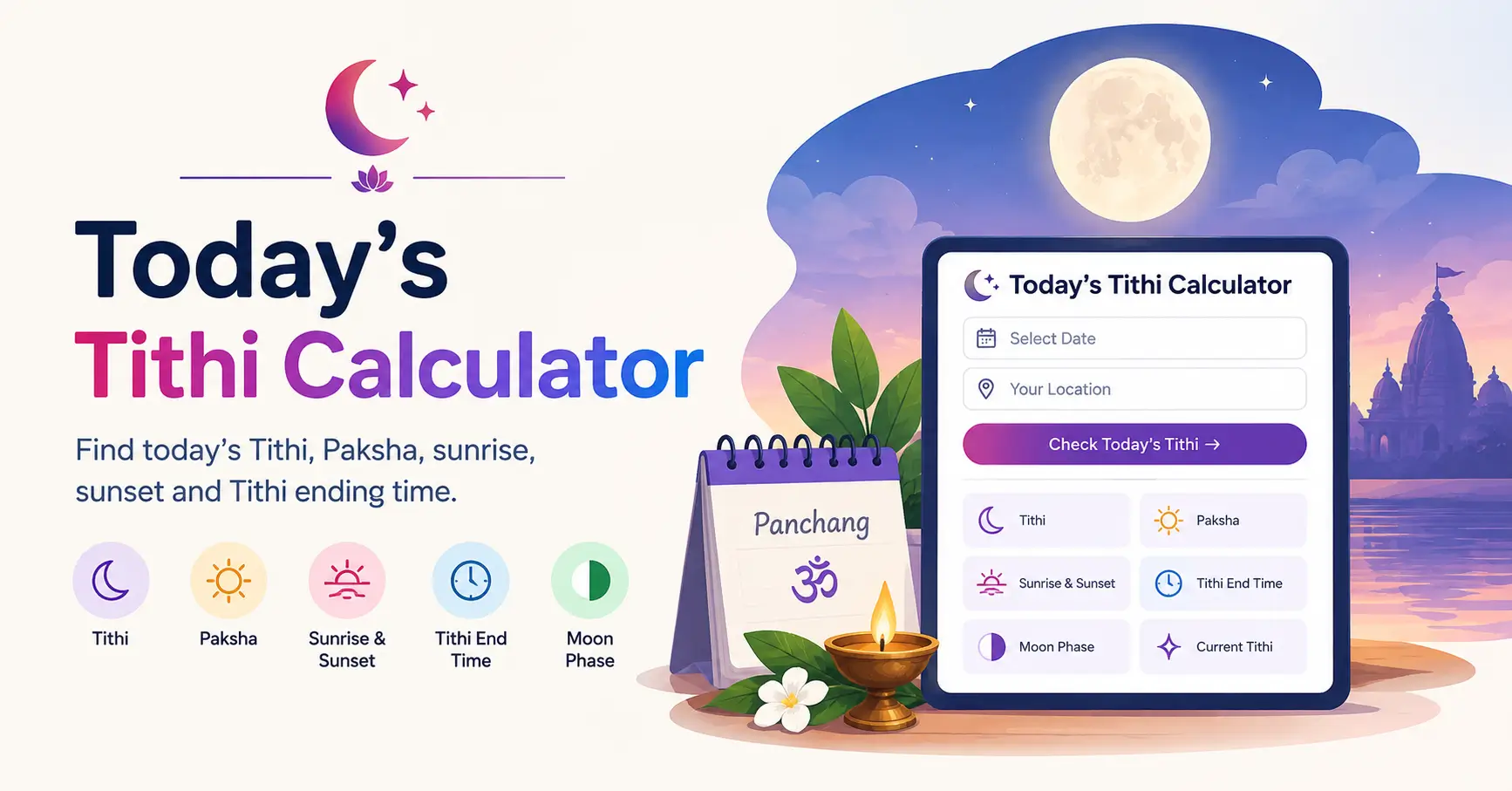
Today’s Tithi Calculator
current tithi, real panchang, zero guesswork
Most people who search for today’s tithi want one of two things: a quick answer to “what’s the lunar day today,” or an exact transition time for something specific, an Ekadashi fast, a puja muhurat, a wedding date shortlist. This guide covers both, along with why two Panchang sites sometimes show a different tithi for the same date, and the mistakes people commonly make when reading one on their own.
Today’s Tithi Calculator
Check today’s Tithi, Paksha, Tithi end time, sunrise, sunset and moon phase.
This calculator uses the astronomical Sun–Moon elongation and local sunrise/sunset for the selected city. For religious vrat or muhurat decisions, verify the result with your family’s traditional Panchang.
How to read today's tithi correctly
Enter your city, or allow the calculator to detect it, and it works out the current tithi from your local sunrise and the live Sun–Moon angle, adjusting automatically as the tithi changes partway through the day rather than at a fixed clock time.
If you're checking it manually against a printed or online Panchang, the reading order is:
- Confirm the date and your city.
- Read the tithi name.
- Check its end time. This tells you whether it holds for the whole day or hands over to the next tithi before the following sunrise.
- Note the paksha, Shukla or Krishna, so you know which half of the lunar month you're in.
- For anything time-sensitive, a vrat, a muhurat, cross-check the timing against a trusted local Panchang rather than going by the name alone.
Worked example: why the transition time matters
Take 15 September 2026. Across Panchang calculators set to Indian locations, Shukla Chaturthi held only until roughly 7:44–7:45 AM IST, after which Shukla Panchami took over and ran until about 8:59–9:09 AM the next morning.
| Time on 15 Sep 2026 (IST) | Active tithi |
|---|---|
| Before ~7:45 AM | Shukla Chaturthi |
| ~7:45 AM onward, into 16 Sep | Shukla Panchami |
Someone checking at 6 AM would correctly see Chaturthi. Someone checking the same date at noon would correctly see Panchami. Neither is wrong, they're just two different moments of the same civil day, which is exactly why a tithi name on its own, without the end time, is an incomplete answer.
Shukla Paksha and Krishna Paksha
Every lunar month splits into two fortnights of 15 tithis each.
| # | Shukla Paksha (waxing, toward Purnima) | Krishna Paksha (waning, toward Amavasya) |
|---|---|---|
| 1 | Pratipada | Pratipada |
| 2 | Dwitiya | Dwitiya |
| 3 | Tritiya | Tritiya |
| 4 | Chaturthi | Chaturthi |
| 5 | Panchami | Panchami |
| 6 | Shashthi | Shashthi |
| 7 | Saptami | Saptami |
| 8 | Ashtami | Ashtami |
| 9 | Navami | Navami |
| 10 | Dashami | Dashami |
| 11 | Ekadashi | Ekadashi |
| 12 | Dwadashi | Dwadashi |
| 13 | Trayodashi | Trayodashi |
| 14 | Chaturdashi | Chaturdashi |
| 15 | Purnima (full moon) | Amavasya (new moon) |
So a calendar reading "Shukla Panchami" is telling you two things at once: you're in the waxing fortnight, and it's the fifth tithi of it.
The five limbs of Panchang
Tithi is one part of a larger daily framework called Panchang, meaning "five limbs."
| Element | What it measures |
|---|---|
| Tithi | Lunar day, based on the Sun–Moon angle |
| Vara | Weekday |
| Nakshatra | Moon's position across 27 lunar mansions |
| Yoga | Calculated Sun–Moon longitude relationship |
| Karana | Half of a tithi, two per most tithi periods |
Tithi and paksha alone answer most day-to-day questions. Nakshatra, yoga and karana matter more once you're checking something specific, like a birth chart detail or a muhurat.
Purnima, Amavasya and Ekadashi
Purnima is the full moon tithi, the last day of Shukla Paksha, and a common reference point for counting other dates in the month.
Amavasya is the new moon tithi, the last day of Krishna Paksha. Many families observe specific rituals or fasting on this day.
Ekadashi is the eleventh tithi, occurring twice a month. It's one of the most widely observed fasting days, and because it follows the sunrise-based tithi rule, the exact vrat date can occasionally differ by a day between two Panchang traditions.
Does tithi change at midnight?
No. A Gregorian date changes at a fixed 12:00 AM everywhere. A tithi changes whenever the Sun–Moon angle crosses the next 12-degree mark, which can fall at any hour. That's why a single civil date can carry two tithis, one active at sunrise and a second one taking over later the same day.
Why tithi also depends on your city
The astronomical moment of transition is the same instant everywhere on Earth, but the local clock time it falls at, and which tithi counts as "in force" for a given sunrise, changes with your time zone and local sunrise. Two cities can show different tithi names for what looks like the same date, purely because their sunrise times don't line up the same way. This is why an accurate tool asks for your city rather than assuming one.
Common mistakes when checking tithi
- Reading only the tithi name and ignoring its end time.
- Assuming tithi changes at midnight like a normal date.
- Treating moon phase and tithi as the same measurement, they're related but calculated differently.
- Using a generic or default city instead of your own location for a time-sensitive observance.
- Comparing two Panchang sources without checking whether they're set to the same city and time.
Tithi vs. moon phase: what's the difference?
They're closely related but not identical. Moon phase describes the Moon's visible appearance, new moon, waxing crescent, first quarter, full moon, and so on. Tithi is a precise calendrical measurement based on the Sun–Moon angle, with 30 fixed divisions per lunar month. The two usually move together, but a phase name and a tithi name aren't interchangeable if you need an exact answer.
Tithi and choosing a date for engagements or weddings
Tithi isn't only used for fasting and festivals. Families and priests often factor it in, alongside birth details, when shortlisting dates for engagements, weddings, or a griha pravesh. If you're planning that far ahead, our Free Marriage Prediction Calculator: When Will I Get Married? is a fun starting point for the bigger timeline question, while your family priest or a trusted local Panchang can confirm the exact muhurat.
Frequently asked questions
What is today's tithi? Today's tithi is the current lunar day per the Hindu Panchang, based on the Sun–Moon angle. Since it changes at a specific time rather than at midnight, check it against your own city and the current time, not just the date.
How many tithis are there in a month? Thirty, 15 in Shukla Paksha and 15 in Krishna Paksha.
Is tithi the same as moon phase? They're related but not identical. Moon phase describes visible appearance; tithi is a precise Sun–Moon angle measurement.
Does tithi change at 12 AM like a normal date? No. It changes whenever the Sun–Moon angle crosses the next 12-degree point, which can happen at any hour.
Why do two Panchang sites sometimes show a different tithi for the same day? Usually a location or time-zone difference, or the two sources being checked at different moments of the day. Align the city and time and they should agree.
Why is the Ekadashi date sometimes different across calendars? Ekadashi follows the sunrise-tithi rule, and different Panchang traditions apply slightly different conventions for borderline cases, which can shift the observed date by a day.
This information is for general and informational purposes. For religious observances, vrats, or muhurat decisions where exact timing matters, verify with your family's traditional Panchang convention or a trusted local source.