
Love Compatibility Test
A quick compatibility test gives you something to talk about that small talk never does, here’s the psychology behind why it works.
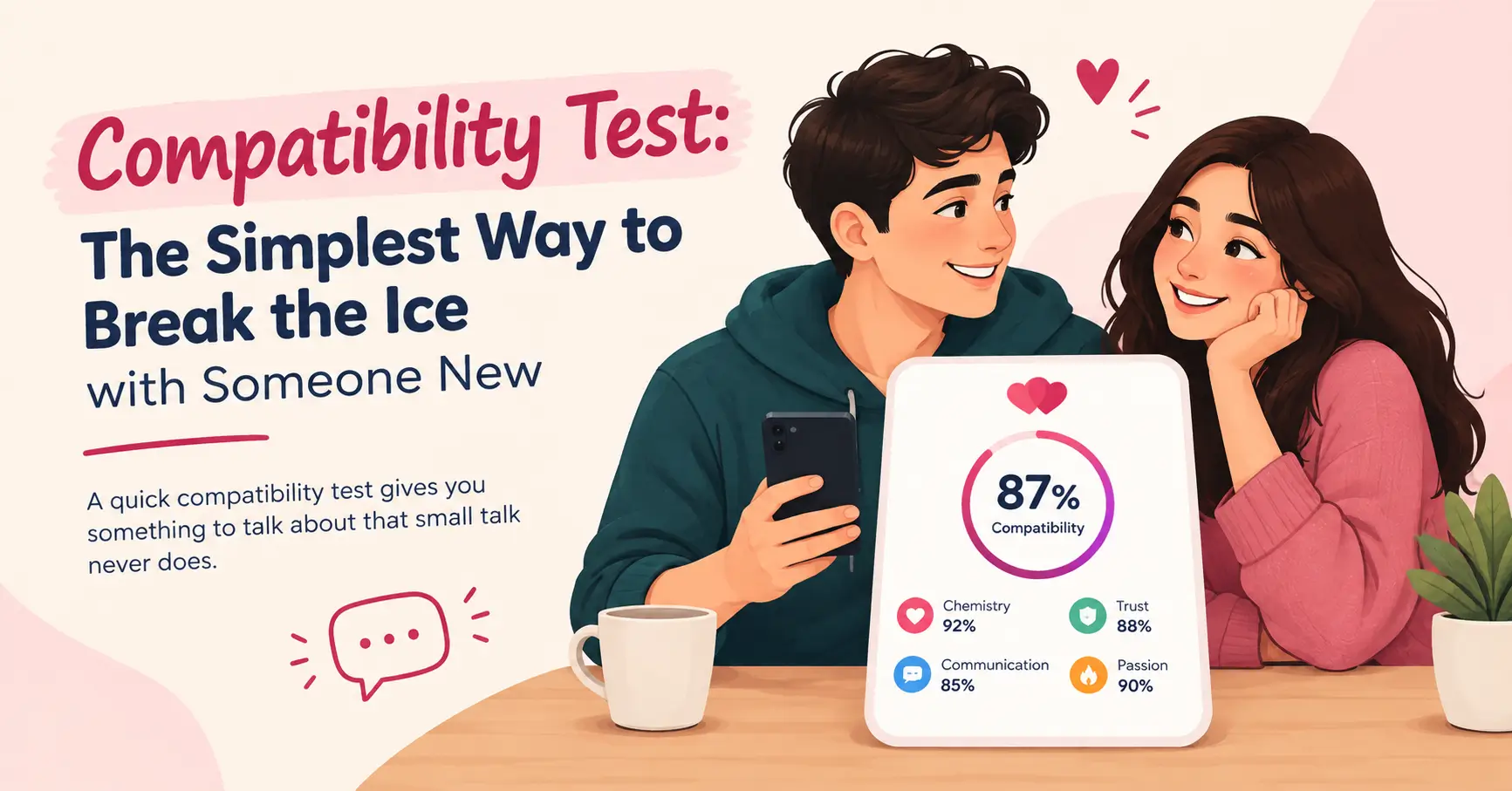
Most people who search for a love compatibility test want one of two things: a fun number to send someone they like, or a low-pressure way to start talking to a crush without sounding like they’re trying too hard. A compatibility test does both. It gives you something specific to react to together, and reacting together is what actually breaks the ice, not the score itself.
This isn’t just a lucky side effect. Psychologists who study attraction and early relationships have spent decades looking at what makes two strangers comfortable enough to keep talking, and a shared, slightly silly activity like a compatibility test checks several of those boxes at once. Below is what the research actually says, plus how to use a compatibility test as an icebreaker without it falling flat.
Want to try it right now? Enter two names and see the compatibility score in seconds, then use the result to start the conversation.
Try the Love CalculatorWhy a Compatibility Test Works as an Icebreaker
Ordinary small talk (weather, weekend plans, “what do you do”) is safe precisely because it’s forgettable. A compatibility test breaks that pattern because it produces a shared result that both people have a reaction to, which gives the conversation an actual topic instead of a script.
It creates a shared reference point
Two people can only bond over something they both experienced. A compatibility score, whether it’s 40% or 94%, is a moment you both just lived through together. That’s a far easier thing to talk about than “so, tell me about yourself.”
It borrows from how real closeness is built
The best-known research on this comes from psychologist Arthur Aron, whose 1997 study on strangers found that structured, gradually escalating self-disclosure, where two people take turns sharing something and responding to what the other shares, produced a measurable increase in closeness in under an hour. A compatibility test is a much lighter, faster version of that same mechanic: you enter something personal (your name, sometimes your birth date), you get a result together, and you react to it together. It’s small talk with a built-in reason to keep going.
It leans on the similarity-attraction effect
Social psychologists have also found, consistently, that people are drawn to others who seem similar to them, not opposite. A 2008 meta-analysis on the topic found perceived similarity to be one of the strongest predictors of attraction between two people. A high compatibility score, even from a playful, non-scientific tool, taps into that same instinct: it briefly frames the other person as “we might have something in common,” which is a comfortable place to start a conversation from.
Compatibility Test vs. Other Icebreakers
A compatibility test isn’t the only way to start a conversation, but it holds up well against the usual options, especially with someone you don’t know very well yet.
| Icebreaker | Effort to start | Best used when |
|---|---|---|
| Love compatibility test | Very low, takes seconds | Texting a crush, group chats, first messages on a dating app |
| “So, tell me about yourself” | Low, but often stalls fast | Formal settings where a compatibility test feels out of place |
| Deep questions (like Aron’s 36 questions) | High, needs 30 to 45 minutes and mutual buy-in | An established relationship or a planned bonding activity |
| Shared activity or game | Medium, needs both people present | In-person dates, group hangouts |
Common Mistakes When Using a Compatibility Test to Break the Ice
- Leading with the number instead of the reaction. “You got a 62%” is a dead end. “You got a 62%, what do you think that even means” invites a response.
- Sending it and going quiet. The score is an opener, not the whole conversation. Follow up on whatever they say back.
- Treating a low score as a real signal. These tools run on names, sometimes birth dates, and simple formulas. They aren’t measuring communication, trust, or shared values, which is what actually predicts whether two people get along. A low score is only a bad conversation starter if you treat it like a verdict.
- Using it somewhere too formal. A compatibility test works well in texts, dating app chats, or among friends. It can land oddly in a professional or very early in-person setting.
How to Actually Use the Result
- Run the compatibility test together, or send your result first so it doesn’t feel like a test they’re being put through.
- React honestly, even a simple “that seems way too high” or “I refuse to believe that” works.
- Ask a real follow-up question that the score gives you an excuse to ask, like what they think makes two people actually compatible.
- Let the conversation move on from the score itself within a message or two. It did its job once it’s not the only thing you’re talking about.
Frequently Asked Questions
Does a love compatibility test actually predict anything real?
No, and it isn’t meant to. Most name-based or date-based compatibility tests run on simple formulas, not psychological data. Relationship researchers consistently point to communication, shared values, and trust as the real predictors of whether two people work, and no quick online test measures any of those. Its value is as a conversation starter, not a forecast.
Is it weird to send someone a compatibility test result out of nowhere?
Generally no, especially over text or in a dating app chat, where a slightly playful, low-effort message is often easier to respond to than a serious one. Keep the tone light and it reads as friendly rather than intense.
What if the compatibility score is low?
Treat it as part of the joke, not a red flag. A low score from a name-based tool says nothing about real compatibility. If anything, a low score can make for a funnier opener than a high one.
What’s a good follow-up after sharing the result?
Ask something the score gives you a natural reason to ask, like what they think actually makes two people compatible, or just keep it playful and ask if they want a rematch with middle names.
Is this the same as a real relationship compatibility test?
No. Tools like this one are built for entertainment and as conversation starters. A genuine relationship compatibility assessment, the kind used in counseling or by researchers, looks at communication patterns, conflict resolution, and values alignment over time, not names or birth dates.
Keep the Conversation Going
Once the ice is broken, these tools on lovecalculatorbynamein.com make good follow-ups:
All the love and compatibility tools in one place.
The compatibility test used throughout this article.
Another playful, low-pressure way to bring up a crush’s name.
A classic name game that works well as a group icebreaker too.
For once the conversation has moved past the first message.
A fresh conversation starter you can come back to every day.
More free ways to test compatibility once one icebreaker isn’t enough.
This article is for entertainment purposes. Compatibility scores from name or date-based tools are not scientific and should not be used to make real relationship decisions.